Wednesday, November 14, 2012

The Hobbit Read-Along, Day 3: Chapters 9-12!


The Wood-elves take the dwarves prisoner at the beginning of Chapter 9 ("Barrels out of Bond"), though all concerned are so hungry and miserable that "they were actually glad to be captured."  Luckily for the dwarves, Bilbo has the magic ring, so the elves don't know he has snuck into their underground realm, where he uses his growing talents as a burglar to find his way around, pilfer food, and discover the deep cell in which the elves are holding Thorin.  (THE HOBBIT is a book very rich in caves, by the way!)  Bilbo's task is to get all those dwarves safely out of prison.  He does this using, as the chapter title suggests, barrels, into which he packs the dwarves in order to float them down the river to the Long Lake.

Bruised and waterlogged, the poor dwarves finally get to crawl out of their barrels, and the Master of the town greets them with some suspicion.  His hand is forced by the townspeople's enthusiasm, however; the people of Lake-town promptly dig up all the old songs about the "return of the King under the Mountain" and sing them with gusto.  That's why Chapter 10 is called "A Warm Welcome"!  Fortunately for the Master of Lake-town, the dwarves are eager to set off in the direction of the Lonely Mountain, and they don't end up lingering too long.

Chapter 11, "On the Doorstep," takes us right to the "skirts of the Mountain," and even farther than that, up to the back door, but unfortunately for them, that door is closed, and nothing they do makes it budge.  It's up to Bilbo to save the day again by figuring out the secret message represented by an enormous thrush busily dining on snails near the hidden door.  Aha!  Just as the moon-letters on the map had told Elrond long before:  "Stand by the grey stone when the thrush knocks, and the setting sun with the last light of Durin's Day will shine upon the key-hole."  (I am impressed by a map thorough enough to mention local birds!)  Sure enough, the sun sets, the key is brought forth, and the stubborn door into the mountain finally opens. 

Does Thorin say, "Why, thank you, Mr. Baggins, for your sharp eye and useful bird-watching habits!  Why don't you take a nice rest now?"?  Why, no, he does not say that.  He says instead, "Now is the time for our esteemed Mr. Baggins . . . to perform the service for which he was included in our company; now is the time for him to earn his Reward."  The narrator, by the way, is much more mocking of a hero like Thorin than the LotR narrator will later be:  "You are familiar with Thorin's style on important occasions, so I will not give you any more of it, though he went on a good deal longer than this."  Poor Bilbo!  He will spend Chapter 12 ("Inside Information")  chatting with dragons.  A particular dragon, that is:  the dragon named Smaug. 

Dragons are tricky conversationalists.  Before Bilbo really understands what Smaug is up to, he spills a little too much information about, for instance, places the company has recently been.  The dragon flies off, intent on showing these bipeds who's in control around here.  Not a good time to be living in Lake-town!

Questions:  More echoes here of Lord of the Rings, did you notice?  A door into a cavern that will only open under very particular circumstances!  Another question:  would you rather ride a river INSIDE or ON TOP OF a barrel?  What does THE HOBBIT teach us about how to converse with ancient and dangerous creatures like dragons?  In his adventures thus far, has Bilbo done something you would find especially hard, if not impossible?  I, for instance, would have quailed in the face of Chapter 8's spiders.  And how how how did the map's rune-writer know that thrush would be there at the appointed hour?

***
Anne Nesbet is the author of THE CABINET OF EARTHS, which came out earlier this year from HarperCollins, and A BOX OF GARGOYLES (appearing in May 2013).  She lives in California (but not the warm part of California) with her dear family and an only moderately well-behaved Border Collie.  More info about Anne and her books at www.annenesbet.com

Tuesday, November 13, 2012

The Hobbit Read-Along: Chapters 5-8!

Today, we continue our group read of The Hobbit by J.R.R. Tolkien, preparing ourselves for the movie coming out next month. Return tomorrow for chapters 9-12!


 “…till suddenly his hand met what felt like a tiny ring of cold metal lying on the floor of the tunnel.”

Did JRR Tolkien have any idea what he was getting us into when he wrote those words? Eighty years later, when someone says “the Ring” they’re probably not talking Wagner.

The chapters we’re discussing today are Riddles in the Dark, Out of the Frying Pan into the Fire, Queer Lodgings, and Flies and Spiders. In addition to introducing us to the One Ring and Gollum, these are the chapters in which Bilbo (and hobbits) come into their own in the wide world.

The summary: Bilbo awakes alone in the dark, having been knocked out and left behind while he, Gandalf, and the dwarves fled the goblins. Groping around in the dark, he finds the ring and sticks it in his pocket, thinking nothing of it. He stumbles upon the underground lake that is home to Gollum, whom Tolkien describes as “a small slimy creature . . . dark as darkness, except for two big round pale eyes in his thin face.”

You can watch Gollum take hold of his author’s imagination. At first, the narrator is dismissive, saying, “I don’t know where he came from, nor who or what he was.” A page later, we learn that Gollum had once played riddle games “with other funny creatures sitting in their holes.” A page after that, we find out Gollum once had a grandmother and remembers sun on daisies.

A high-stakes riddle game ensues—if Bilbo wins, Gollum shows him out of the goblins’ maze of tunnels; if Bilbo loses, Gollum eats him. The score’s tied when, desperate for a new riddle, Bilbo fumbles in his pocket, feels the Ring, and muses aloud, “What have I got in my pocket?” Gollum takes this as a riddle question, can’t guess, then makes an excuse to fetch his own ring—a magic one that, to his horror and despair, turns out to be gone. “What has it got in its pocketses?” he hisses, and the chase is on. Bilbo learns that the Ring makes him invisible, and Gollum unwittingly shows him the way out of the goblins’ realm.

In one of my favorite scenes—bursting with typical Tolkien humor—an invisible Bilbo squeezes through a doorway gap to escape, mystifying the pursuing goblins when his waistcoat buttons pop into view scattered on the ground.

Bilbo reunites with Gandalf and the dwarves—tellingly, he neglects to mention the Ring. Our heroes are treed by wolves and goblins, who set the trees on fire. The eagles come to the rescue—foreshadowing future events not only in this book but in The Lord of the Rings.

After an utterly charming scene in which Gandalf wins hospitality through a good tale, the troupe enjoys a little R&R with Beorn, the shape-shifter and animal lover. Beorn helps them find the entrance to the path they must follow through Mirkwood. As this exceedingly mysterious and dangerous leg of their journey is about to begin, Gandalf leaves for mysterious duties elsewhere.

Despite Beorn’s warnings, the dwarves are lured from their path by the sounds of elvish feasting, then captured by giant spiders. (And may I just say . . . ew). Bilbo, who has been growing in cleverness and bravery the deeper he journeys into the woods, uses the Ring to save everyone but Thorin, who is captured by the elves.

Discussion questions: The Bilbo who emerges from these four chapters is a very different little chap from the Bilbo who got left behind as the chapters started. Which events do we think contributed most to his growth?

Tolkien is careful to build in rest periods: Rivendell in yesterday’s chapters, the Beorn sojourn in today’s. How important is this to you as a reader? Are you charmed or bored?

Bilbo’s uncharacteristic attempt to keep the Ring secret has great significance in The Lord of the Rings, when Gandalf cites the lie as his first clue that this wasn’t just any magic ring.  In this book, though, it strikes me as an odd loose end. Gandalf gives Bilbo a funny look when he initially misleads everyone, but never refers to the incident directly again. Is this a flaw, or just Tolkien playing a deep game? (We do know he’d started the trilogy before The Hobbit was published.)

What about old Gandalf? Why’d Tolkien choose to send him away at this juncture?

In addition to the ring, Gollum, and the eagles, what other aspects of these chapters do we think foreshadow events in The Lord of the Rings?


***

Ellen Booraem is the author of the middle-grade fantasies THE UNNAMEABLES, SMALL PERSONS WITH WINGS, and TEXTING THE UNDERWORLD (coming in August 2013). She lives in coastal Maine with an artist, a dog, and a cat, one of whom is a practicing curmudgeon. She's online at www.ellenbooraem.com.


Monday, November 12, 2012

THE HOBBIT READ ALONG! CHAPTERS 1-4


Chapter One: An Unexpected Party

In Chapter one, Tolkien introduces us to Hobbits, and in particular, our protagonist, Bilbo Baggins. Now Bilbo, who “looked and behaved exactly like a second edition of his solid and comfortable father, got something a bit queer in his make-up from the Took side, something that only waited for a chance to come out.” Chance – otherwise known as the Wizard Gandalf – did indeed show up at Bilbo’s door one morning, and changed his life forever.  Soon after Gandalf made his appearance, a company of Dwarves came to visit -- under the impression that Bilbo was a burglar and available to assist them on their quest to retrieve their treasure, stolen by the evil and deadly dragon, Smaug.

 Music and song is an important part of The Hobbit, and it is introduced in the very first chapter. When the Dwarf Thorin played his golden harp, Bilbo “forgot everything else, and was swept away into dark lands under strange moons, far over The Water and very far from his hobbit-hole under The Hill”.  Of course, as Bilbo is transported by the music, the reader is transported by the story – far away from our own little corners of the world.

From the beginning, the reader learns that there are two sides to Bilbo: his respectable Hobbit self, and his “Tookish side”.  As the dwarves fell into song, Bilbo suddenly wished to go on an adventure, to see the great mountains and waterfalls, and to exchange his walking-stick for a sword. Soon after, when Thorin described the dangerous adventure and warned that they “may never return”, Bilbo shrieked in fear and had to go lie down to calm himself.  And yet, when he overheard the Dwarves doubting his courage and scoffing at him as a burglar, “the Took side won” and Bilbo volunteered for the job.

 Did this surprise you?  If you were Bilbo, would you have run off with the Dwarves on this dangerous adventure?

What did you think of the company of fourteen?  Would you trust Gandalf and the Dwarves if you were Bilbo?  Do you think they were all being honest with each other?

 Chapter Two: Road Mutton

 Bilbo’s “Tookishness” wore off at the end of Chapter One, so when he woke up and discovered that he was alone, he was quite relieved at first.  And then . . . he felt a bit disappointed.  Of course – he had not been left behind. Gandalf showed him a note – which was more like a contract for his services as a burglar – and Bilbo hurried off without even time to grab his hat or walking-stick!

The journey started “very merrily”, and Bilbo began to feel “that adventures were not so bad after all.” But as they traveled, the weather turned cold and dreary.  One evening, after they crossed a swollen river, they noticed that Gandalf was missing.  It was too damp to light a fire (and they had no wizard to help them!) so when they saw a light shining in the distance they sent the burglar to investigate.  Off Bilbo went, and discovered three trolls sitting around a fire, eating. Instead of going back to warn the Dwarves, Bilbo’s “Tookish” side won again, and he decided to pick the trolls pockets, as any good burglar would.  Bilbo, who “had read of a good many things he had never seen or done”, did not know that Troll’s purses “are the mischief” and this one squeaked out: “’Ere, ‘oo are you?”

As the Trolls fought about what to do with Bilbo, the Dwarves came to see what happened to him, and they were all caught, while Bilbo – who the Trolls had forgotten about -- hid in a bush. As the Trolls argued about how to best kill the Dwarves, Gandalf returned and hid behind a tree, where he imitated a Troll’s voice to keep the Trolls arguing until the sun rose, and they all were turned to stone.  They discovered the Troll’s cave, and found food, gold coins and swords. Gandalf and Thorin each took a sword with jeweled hilts in beautiful scabbards, and Bilbo took a knife. 

Where do you think Gandalf disappeared to when the dwarves were captured by the trolls?  Do you think his explanation about going up ahead to spy out the road was true?

 Chapter Three: A Short Rest

 The Troll food ran out, and the party began “to feel that danger was not far away on either side.”  At last they came to the great Misty Mountains, stretching across the horizon.  Gandalf lead them to the “Last Homely House” before they crossed into the Wild – Elrond’s house in the secret valley of Rivendell – where they met the elves. They stayed fourteen days, and their stomachs and bags were filled and their plans improved.  Elrond told them about the two old swords, which were made by the High Elves of the West.  He also made a startling discovery -- there were moon letters on the map of Smaug’s lair!   Moon letters are rune letters that can only be seen when the moon shines behind them – but “it must be a moon of the same shape and season as the day when they were written.” The moon letters described the location of the key hole.  They left the next day on a beautiful midsummer’s morning, “with their hearts ready for more adventure . . .”

The narrator states: “Now it is a strange thing, but things that are good to have and days that are good to spend are soon told about, and not much to listen to; while things that are uncomfortable, palpitating, and even gruesome, may make a good tale, and take a deal of telling anyway.”  What do you think about that?

The Dwarves think the elves are foolish. What do you think? Do you think these Dwarves still think that elves are foolish?

Chapter Four: Over Hill and Under Hill

Adventure they soon found . . . and not at all the type they were looking for. As a wild thunderstorm – a “thunder-battle”-- erupted over the mountain, the party retreated to a seemingly empty cave, and soon they all drifted off to sleep.  Luckily, Bilbo was plagued with disturbing dreams of a crack in the cave wall – which ended up being true! He awoke with a start just in time to see their ponies and gear disappear, and screamed. Out jumped lots of big, ugly goblins, but fortunately his yell woke Gandalf – and then there was a flash like lightening – and several goblins fell dead and the crack closed.  Unfortunately, Gandalf was on the other side of the crack, and Bilbo and the Dwarves were taken prisoner, chained together and brought before the Great Goblin.  When he saw Thorin’s sword – aptly named Orcrist – the Goblin-cleaver -- he howled in rage, for the sword had killed hundreds of Goblins, and ordered the prisoners to be beaten, bitten, slashed, gnashed and finally taken to a hole full of snakes. 

Just then a tower of blue smoke erupted, and a sword flashed and killed the Great Goblin.  It was Gandalf! His sword, Glamdring (which the Goblins hated even more than Orcrist) cut through the chains that bound Bilbo and the Dwarves, and they hurried along the dark passages.  But the goblins chased after them, and since Bilbo could not go half as fast as a Dwarf – they took turns carrying him.  When Dori – who was in the back carrying Bilbo -- was grabbed, Bilbo rolled off his shoulder into the darkness, hit his head, and was knocked out.

As in other parts of the story, the narrator tells the reader what’s about to happen in this chapter, warning “And that was the last time that they used the ponies, packages, baggages, tools and paraphernalia . . .” before it happens.  Do you think this lessens, or increases the suspense?

In this chapter the Goblins sing a song. Now the reader has heard songs from the Dwarves, Elves and Goblins.  What do we learn about the different races from their music?

The narrator tells the reader that goblins are “cruel, wicked, and bad-hearted”, and further states they may have created “some of the machines that have since troubled the world, especially the ingenious devices for killing large numbers of people at once . . . but in those days and those wild parts they had not advanced (as it is called) so far.”  Knowing The Hobbit was first published in 1937, what machines do you think he is referring to?  What do you think Tolkien’s view was about war?

Wednesday, November 7, 2012

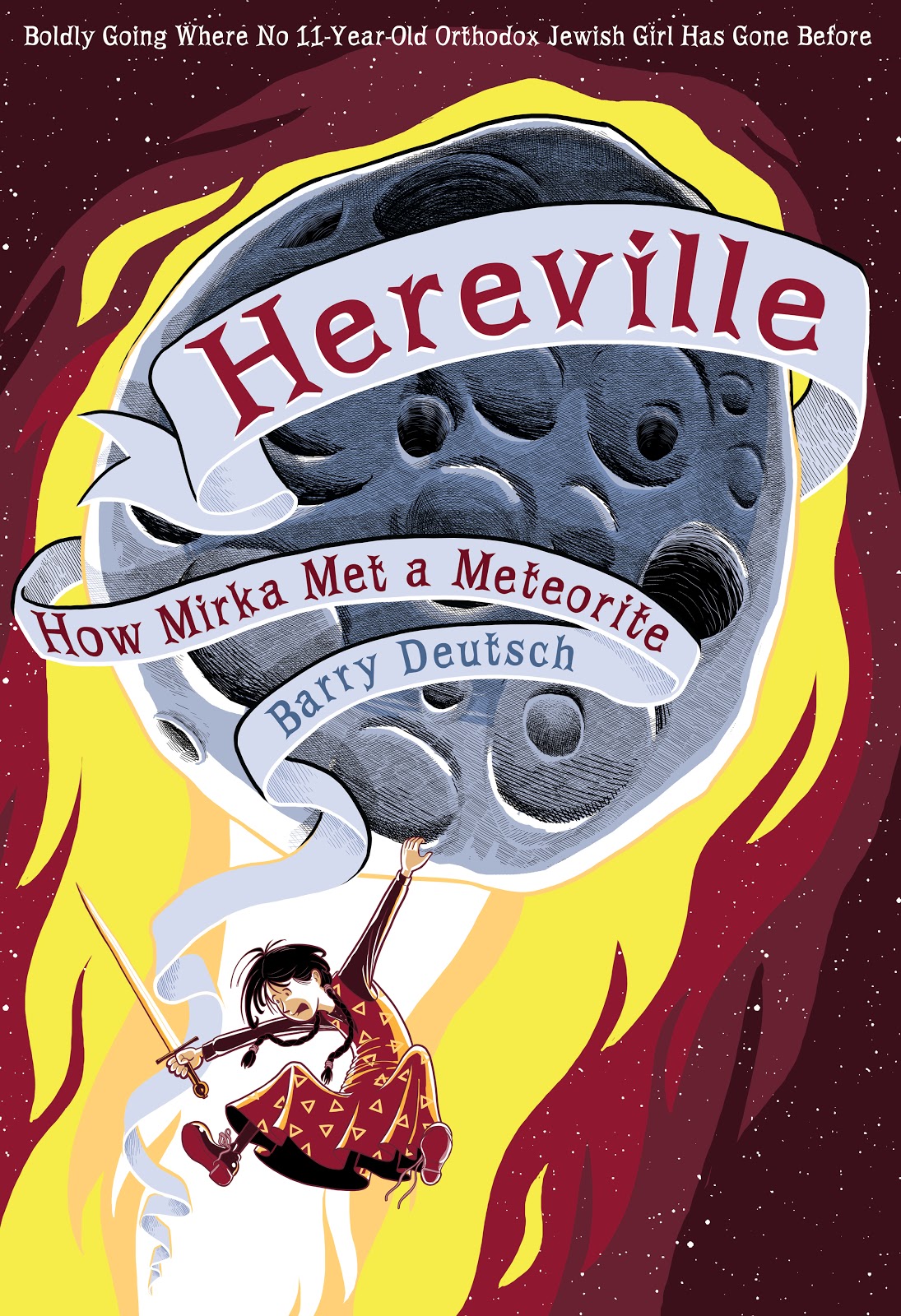
Interview with Barry Deutsch, author of HEREVILLE: HOW MIRKA MET A METEORITE


We are pleased to welcome back to the Inkpot Barry Deutsch, who has the distinction of being the first graphic novelist ever featured on the Inkpot! The first book in his Hereville series, How Mirka Got Her Sword, was featured here in 2010. Today Barry is back to talk about the just-released sequel, How Mirka Met a Meteorite.

Hi, Barry, and welcome back! The second Hereville book was fantastic, both similar to and different to the first. One minor thing I noticed in this book that wasn’t in the first – cars! Back when I interviewed you about the first Hereville book, you told me you didn’t enjoy drawing cars; what changed?

You've got sharp eyes!

I still don't enjoy drawing cars, but I grit my teeth and drew a few this time (although only a few!), and I'm happy with how they came out. The panel on page 12 with the VW bug in the background probably took me longer to draw than any other panel in the book. (Not just because of the bug, but because of all the houses. I had originally laid out this sequence in the woods, but a cartoonist friend of mine, Mathew Bogart, pointed out that I was cheating the reader by not showing Mirka's neighborhood.)

I decided to include cars this time, even though I don't like drawing them, because I wanted to give readers another hint that Hereville takes place in the modern day. Even though there's some modern technology in book one, a lot of readers came away with the impression that Hereville was set in the 19th century or even earlier. I don't mind that for these early stories -- it's good if Hereville has sort of a timeless feeling -- but eventually the outside, modern world is going to intrude on Mirka's life, and I don't want readers to feel that I've yanked the rug out from under them.
 
Also new for this book, you’re collaborating with another cartoonist, Tina Kim, who is drawing some of the backgrounds. How did that come about and how has it changed your working process?

To be honest, I asked Tina to join in so I could meet the publication deadline. The cartoonist Steve Lieber, who is sort of the hub of Portland cartooning, recommended Tina to me, and as soon as I saw her work I could see why.

Most of the backgrounds I drew, but on about 35 pages Tina did the backgrounds. For the pages Tina and I worked on together, I would draw all the characters and word balloons to completion, and then send Tina the page along with some notes about what I imagined the scenery was like. Sometimes I'd also tell her about specifically Jewish elements to include (like mezuzahs).

Tina would then send me back the pages with backgrounds she made up roughly drawn in, I'd let her know if there was anything I thought needed changing (there usually wasn't), and then she'd finish the page.

Right at the start of our working together, Tina sent me a sample drawing of woods, and I spent an enjoyable hour figuring out a five-step plan for converting Tina backgrounds into Barry-like backgrounds. :-)

The nice thing about working with Tina, aside from her considerable drawing chops, is that she's a real cartoonist with a good storytelling sense. For instance, for a scene where Mirka walked into an alleyway, Tina went a page or two back and showed that the characters were approaching the mouth of the alley; she's thinking of making the story work, not just making individual drawings that look nice.

The funny thing about all this collaboration with Tina is that I still haven't met her! I'm not even sure what city she lives in! We just work and communicate across the internet.  

I also noticed that there were fewer footnotes this time around. Was that a deliberate decision?

No, not deliberate at all. I hadn't even noticed that before you asked me.

I guess it just turned out that way. For what it's worth, I had much better Yiddish advisers this time around, and so I think the Yiddish is of higher quality than it was in the first book. Although my favorite bit of Yiddish in this book is one I found myself -- the sound effect "zetz," which means "pow!" 

Did you do any additional research for this book (i.e. into Orthodox Jewish life, or the secret lives of meteors…?)

Oh, definitely. There's always new research to be done, new books to be read, and it's one of the more enjoyable parts of my job. (Is this a job?)

After the first Hereville book came out, I read a review which mentioned that I had obviously been influenced by Ayala Fader's book Mitzvah Girls. And I had never even heard of it! But because of that review, I bought a copy, and it was really excellent, full of useful information. 

But now let’s talk about some things that are the same: Yarn & knitting still play a large part in the plot, Shabbos plays a central role, Mirka has a very non-evil stepmother and visions of her mother help her out when all seems lost. Are those themes you see continuing throughout the series?

(In this case, it wasn't so much visions of her mother, as it was visions of her great-great-great grandmother.)

Goodness, that's a lot to cover!

Yarn and knitting aren't something that I see continuing throughout the series. To tell you the truth, I hadn't even intended to include yarn and knitting in this book - I worry that if yarn is always included in the plot, that will seem gimmicky. But then one day, lying in bed, the ending and opening of the book came n a flash, knitting and all, and I couldn't not do it.

I think of Shabbos in Hereville sort of like Quidditch in the Harry Potter novels - this pattern of taking a break from the main story so we can do something else for a bit. I don't know if every Hereville book will have a Shabbos sequence (although maybe), but I hope that every Hereville book will show living a Jewish life as integral to the main character, while still keeping things fun and non-preachy.

Mirka is a character who carries scars from the loss of her mother when she was terribly young. In the first Hereville book, I wanted to show those scars, but I also wanted to show how the memory of her mother could bring Mirka solace as well as pain. In the second book, I tried to show how Mirka's ancestry could be a source of strength, but in this case it was a more distant, conversational encounter, not the heart-wrenching encounter we saw in book one, because of course Mirka's great-great-great grandmother isn't as close to her heart as her mother is.

I don't specifically plan these things out -- "Oh, Mirka has to have a vision of a female ancestor on page 100," or anything like that. But these are things that fascinate me -- the way that who we are is mixed up with who our ancestors were, and how a girl like Mirka continues to define herself partly in relationship to a mother who passed away years ago. So I'm sure I'll be touching on those themes again, whether I intend to or not. I'll try not to repeat myself too much.

And as for Fruma, yes! Fruma is also Mirka's mother, and I really wanted to do a stepmother-daughter relationship that, for all that it gets rocky, is based in love. The relationship between Fruma and Mirka is, for me, an essential part of Hereville, and I'm sure I'll go there again and again.

In one of my favorite sequences, Mirka’s stepmother says, “Oh, good. Adolescence.” Does that signify what’s ahead for Mirka?  (You can basically read this question as: give us a hint of what’s to come, please!)

That's such a great line, and it's not even mine! My friend Rachel Swirsky (who is a great writer) suggested that Fruma say that.

Assuming I get to keep doing this for a living - and what a lucky boy that would make me! -- we will definitely see Mirka get older; we'll see Mirka as a teenager, and Mirka as a young adult. But we're first going to have one more book set when Mirka's 11 years old.

Thanks, Barry – I’m looking forward to it!

You can read more about Hereville at its website: http://www.hereville.com/


Sunday, November 4, 2012

YA at World Fantasy Con!


Last Thursday, almost 700 authors, illustrators, editors, booksellers and fans descended on my home town of Toronto for the 38th annual World Fantasy Convention.  Grey weather from the tail end of Hurricane Sandy could not dampen the mood, although unfortunately some of the attendees had to cancel at the last minute due to the storm. 

From Thursday through Sunday, our days and nights were packed with lectures, readings, panels, book signings and parties.  As I did with last year’s wrap-up, I must begin with an apology.  So much was going on concurrently that no WFC attendee could possibly take it all in, and no two attendees would ever have the same experience—so I hope readers will understand that this is just a taste of what went on during those fabulous four days. 

These were some of the panels and discussions that I enjoyed, but I hope other attendees will tell us their favourites in the comments section—and post links to their pics!

Young Adult Urban Fantasy
with Joel Sutherland, Holly Black, Isobelle Carmody, Charles de Lint, Alyxandra Harvey, and Leah Petersen.

Authors Holly Black and Alyxandra Harvey
 Author Gillian Chan and Author/Librarian Joel Sutherland

Canadian Librarian Joel Sutherland led this lively discussion about the appeal of YA urban fantasy.  “Urban fantasy is gateway fantasy!” Holly Black said, making the point that a realistic, contemporary setting can be less intimidating to those new to the fantasy genres. 

Charles de Lint, considered by many to be one of the inventors of urban fantasy, surprised everyone by saying he didn’t use the term when describing his own work; he preferred the expression “mythic fantasy” because, although his books usually have a contemporary setting, they don’t always take place in a city, and to him the city is a key element of urban fantasy.  Most of the panel agreed, and certainly a city setting is crucial to many seminal works of YA urban fantasy such as Cassandra Clare’s Mortal Instruments series. As Holly Black put it: “The city is the new forest; the city is now the place we go to be transformed.” 

When panelists were asked why they wrote YA and not adult urban fantasy, Leah Petersen summed it up perfectly: “Because YA is about firsts—first kisses, first love, first coming into your magic…  Teens are doing these things for the first time—and I love to write about that.”

Garth Nix Reading from Clariel

Sabriel, Nix’s lyric high fantasy about a female necromancer (or “abhorsen”) who puts the walking dead back in their graves, is wildly popular, as are its two sequels.  However, the forth book, Clariel, has been a long time coming—and Nix’s readers were beginning to get restless.  As one fan on Goodreads put it: “If I die before this book comes out, Garth, I assure you that no Abhorsen will be able to prevent me from coming back for it.”

I’m happy to report that Clariel exists.  Nix read the prologue and first chapter to an enthusiastic audience and told us that the book would be out in 2014.

Artist Guest of Honour, Richard A. Kirk

At some World Fantasy Cons it’s hard to remember that it’s not all about the writers—but Richard A. Kirk never let us forget that fantasy illustrators are also honoured and represented at the event.  Not only our programs, but even our con badges and pocket guides were covered with his strange and surreal drawings. Alternately beautiful and nightmarish, Kirk’s work never fails to be arresting, from his illustrations of Clive Barker novels to his album covers for the rock band Korn.  (Also, I was on the Our Selves, Our Monsters panel with him and I can attest that he is an utterly lovely man.) If you have a few minutes, take a look at the galleries on his website.

Diversity and Difference in YA Fantasy
with Kathy Sullivan, Cinda Williams Chima, Megan Crewe, EC Myers and Cheryl Rainfield

Although the panel began by discussing some alarming events, such as the recent cover whitewashing of books by Justine Larbalestier and Jaclyn Dolamore, they were mostly optimistic about the changing views about diversity and difference in YA lit.  We’re seeing more main characters of colour, such as Crewe’s heroine in The Way We Fall and in books by authors like Malinda Lo
and Cindy Pon. 

Rainfield has summed up the talk on her blog and included an excellent booklist.

Authors Cheryl Rainfield, Megan Crewe and Kathy Sullivan
Charles de Lint’s Jam Sessions

On both the Friday and Saturday nights, author and musician Charles de Lint played impromptu folk music for World Fantasy Con attendees with a variety of other artists.  It was a great way to decompress after a long and busy day.

Author Charles de Lint
Author/Illustrator Martin Springett


Romancing the Monster
with Nancy Kilpatrick, Patricia Briggs, Sephira Giron, Maureen McGowan and Chris Szego

This panel dug beneath labels like “dark fantasy” and “paranormal romance” to see what lay below.  What we learned: monsters have rules, real humans don’t—dating a vampire has specific risks, but the risks of dating humans are amorphous and undefined.  So is dating a vampire safer than dating a man?  “It’s very appealing to be able to turn a beast into someone that loves you,” Patricia Briggs commented.  “That’s a lot of power.” Nancy Kilpatrick had the last word when an audience member asked if the panelists got turned on while they wrote.  “If I’m not turned on, I’m not doing it right!” she said.

Authors Nancy Kilpatrick & Sephira Giron, bookseller Chris Szego and authors Patricia Briggs & Maureen McGowan

 Some Favourite Quotes from the Conference

Authors Mette Harrison and Cinda Williams Chima
“If you think teenagers aren’t having sex, I wish you’d been my parents.”  Laura Anne Giman when asked whether there was too much sex in YA.

“Horror is the literature of hopelessness; fantasy is the literature of hope.”  Patricia Briggs.  (Horror writer Sephira Giron disagreed!)

“In horror you survive; in fantasy you triumph.”  Tanya Huff

“When I picture urban fantasy, I think of the bastard love child between fantasy and romance.” S. M. Stirling

“If you can remove the romance and still have a plot it’s urban fantasy; if you can’t, it’s paranormal romance.” Ginjer Buchanan

“Reality is a crutch for people who can’t handle fantasy.” Geoff Hart

“One of the great things about fantasy is that it is metaphor actualized.  (In a changeling story) not only do you feel alien; you are alien.”  Holly Black

“For me, fantasy is a way into philosophy; it’s the way to grapple with the big questions.”  Isobelle Carmody

The dealers' room
The World Fantasy Awards

Finally, on Sunday afternoon we all got into our finery for the World Fantasy Awards Banquet.  Winners were:

Life Achievement
Alan Garner
and George R.R. Martin
Novel
Osama by Lavie Tidhar (PS Publishing)

Novella
“A Small Price to Pay for Birdsong” by K.J. Parker (Subterranean Winter 2011)

Short Story
“The Paper Menagerie” by Ken Liu (F&SF 3-4/11
Anthology
The Weird by Ann & Jeff VanderMeer, eds. (Corvus; Tor, published May 2012)


Collection
The Bible Repairman and Other Stories, Tim Powers (Tachyon and Subterranean Press

Lena Coakley’s first novel, Witchlanders, was called “one stunning teen debut” by Kirkus Reviews and won the SCBWI Crystal Kite award for the Americas.  It is a 2013 MYRCA nominee and a 2013 OLA White Pine nominee.  Lena is also the author of two children’s picture books and the former administrative director of CANSCAIP. Learn more about her at www.lenacoakley.com