Monday, September 30, 2013

Fall MG Covers: The Light Fantastic

Every season seems to have its dominant graphic themes, as designers do their best to drag us across the bookstore and make us pick up That Book.

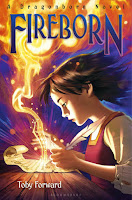
This fall, middle grade fantasy covers are calling us to the light. Usually, it’s a blazing sky with one or more heroes either hurling themselves into it or running for their lives. But who can say no to flashes of lightning, glowing gizmos, or good old-fashioned magical energy?

I have to say, I like the fact that so many covers show boys and girls battling demons (or whatever) together and as equals. No more boys with swords, girls standing there looking scared. We're making progress!

Designers this fall also are fond of the “magical peephole” technique, in which the solid plane of the cover is broken by a circular portal to a fantastic world we want to see more of.  

As always, some designers use a sprightly cartoonish style to reassure us that all will be well. How bad can a zombie apocalypse be if it’s comic?

And then there are those who invent cool graphics to tell their tale: The forthright Flora matched with the flowing fonts of FLORA & ULYSSES, or the marvelously shifty Alexander Baddenfield and his cat. Being a typeface fanatic from way back, I’m drawn to THE CREATURE DEPARTMENT’s amazing alphabet.

As always, we’ve spread our parade of covers over two days. Come back tomorrow for a content-oriented post: Dragons! Princesses! And, of course, cats.

We’re featuring books published July-December, 2013. If we overlooked an amazing cover, please link to it in the comments. And tell us which cover is your favorite!

Click the link to see more covers . . .


I will face this scary flaming thing alone!


Wednesday, September 25, 2013

Interview with Swati Avasthi, author of CHASING SHADOWS

I am thrilled to welcome to the Inkpot Swati Avasthi, author of CHASING SHADOWS, a novel told in words and images. Just released yesterday, CHASING SHADOWS already has two starred reviews and is a Junior Library Guild Selection.

SPLIT (which was one of my favorite books of 2010, by the way!) was a contemporary novel with a single male protagonist. CHASING SHADOWS has two main female characters and incorporates both fantasy and comic-style art sections. Can you tell us a little about the similarities and differences between the books?


Thanks, Leah!  SPLIT is about what happens after chronic violence ends, after the escape from an abusive household. CHASING SHADOWS is also a post-violence story, about what happens after a sudden, unexpected act of violence interrupts a violence-free life. Both books focus on coping and who you hurt in that process.

But, as you mentioned, they are also very different in form and in tone.  I wrote CHASING SHADOWS in part as a response to a moment in my own life when I was faced with the notion that safety is an illusion, that death can show up at any time.  When I was 18, a friend I had had in middle school and had not talked to after we went to different high schools, was shot and killed in what is still an unsolved murder.  The moment I found out, all my words left me.  Words couldn't encompass the shock.  I wanted to capture that moment and I knew words weren't the way.  So I turned to images. So the form was really different.

I wrote it in girls' voices because I feel like friendships, more than boyfriends who sort of came and went, were more of how I came of age.

Wow. I’m so sorry about your friend’s tragedy – that’s terrible. It is wonderful to see more books focusing on friendship, though.

How did you get the idea to incorporate comic-style art sections, and how did you get your publisher – and the artist – on board?

My editor, Nancy Siscoe, is a brave and patient woman -- that's how.  I had a two-book contract for SPLIT plus one.  When I approached Nancy with the idea, she hopped on board pretty quickly, particularly after I showed her the way I was thinking of blending the two.  She was a great help on this novel, seeing a story in what was really a mess of ideas and always keeping me focused on what I was trying to say.

I was very lucky she and Sarah Hokason, the art editor, found Craig Phillips and brought him and his beautiful art to the book.  I wrote the script (the panel layouts, what I wanted in the panels, and the text).  Occasionally, the visual problems were bit too complicated for me to solve and Craig came up with some beautiful solutions.  Questions and notes were passed from artist to art editor to literary editor to writer and vice versa.  

While it was a bit like playing operator, I felt surprisingly comfortable with the process, which is a tribute to Nancy and Sarah.  Nancy and I spent hours upon hours on the phone working through moments and notes.  At one point, I thanked her for how much input she was allowing me to give.  She replied that she couldn't do it without me. At that point, I realized how hard Nancy, Sarah, and Craig were working to realize the vision I had.  I can't thank them enough.

Were there any specific comics that inspired the story (or that you just happen to love and want to talk about)?

In CHASING SHADOWS, one of my narrators, Savitri, retells the Hindu story she was named after, Savitri.  The first time I read that story, I read it as a comic from Amar Chitra Kata, an Indian publisher.  Obviously, I loved it.  It influenced the book, for sure, but it also influenced me and the way I thought about loyalty, which really plays into the story and into CHASING SHADOWS.

I didn't really read American superhero comics until I started writing this story.  But I love THE KILLING JOKE and THE JOKER.  Those were my favorites and, in fact, there's an epigraph in the book from THE KILLING JOKE.

I know it is unconventional, but I believe that villains and antagonists are done better in comics and graphic novels than in any other form. The immediacy of the conflict, the way that they invite the reader's imagination, their complicated motivations (sometimes) are really compelling.  Comics are rooted in the antagonist's realm, in my view.

Your book incorporates extreme freerunning, a sport that both intrigues and kind of scares me. Do you freerun? And if not, what kind of research into freerunning did you do?

Oh, I don't free run, but I love it!  The things that they do stun me -- leaping from 20 feet, running up walls, flipping over people.  It's kind of superhuman, right?  My research was actually quite extensive.  I was lucky enough that one of the few freerunning gyms in the country, Fight or Flight Academy, is located about 10 miles from my house.  One of the owners, Chad Zwallo, happened to be teaching a class at the gym where my kids were doing gymnastics.  So I sought him out and he was a wealth of information and help.  He read the book for me while in draft to make sure I had both the philosophy and the moves down.  Now, my kids have both done freerunning and one has been at it for two years.

Thanks so much for having me on your blog! I appreciate it!

How serendipitous for both you and your kids! Thank you for telling us so much about your book and your process!

You can find out more about Swati and her books at her website, http://www.swatiavasthi.com/

Monday, September 23, 2013

Guess the MG & YA Fantasy Book Covers: Back-to-School Style

It’s September – the month of back-to-school, shiny apples, and changing leaves… and a new round of Guess the Fantasy Book Covers!

As with our first round back in June, the author names and titles have been cleverly edited out of these MG and YA book jackets.  Do you have what it takes to identify them anyway?

You get one point for the correct title and another for the correct author. Books span the years from 1959 to 2013, and we use the first hardcover edition whenever possible (and, Lena says, with some exceptions! :)).

Ready? Pick up your pencils and begin!

Scoring system:

0-7 points:  Time to hit the books and do some extra-hours study.
8-13 points:  You’ve earned an E for effort.  A few more pop quizzes and you’ll be up to speed.
14-19 points:  Go to the head of the class!  You get all the stars.
20 points:  Good heavens – you must be the teacher!

Answers at the bottom!

1.

2.

3.

4.

5.

6.

7.

8.

9.

10.

As before, this post was a tag-team effort between me, Lena Goldfinch, and the wonderful Amy Greenfield. We had so much fun putting it together, we're tossing around the idea of doing it again!

Confession, I'm to blame for stripping these beautiful books of their titles & author names, with sincere apologies to book designers everywhere, and Amy deserves the credit for scouting out a fabulous selection of book covers for me to choose from & for introducing our game.

Here's a little more about us and a look at our own book covers stripped of their titles & author names – just for fun.

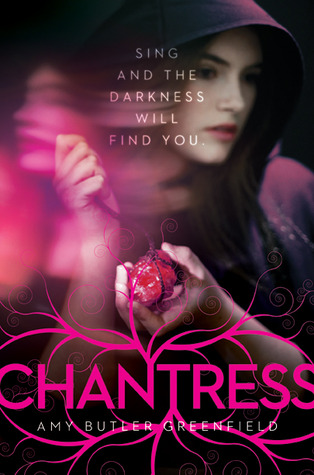
AMY BUTLER GREENFIELD was on her way to a history PhD when she gave into temptation and became a novelist. She loves music, romantic adventure, alternate history, and twisty plots, which explains how she came to write her first YA novel, Chantress (McElderry/S&S, May 2013).


LENA GOLDFINCH writes young adult fantasy with a healthy dose of "sigh-worthy" romance. In her creative heart, she loves travelling to all sorts of exciting places, past and present, a perk of making things up for a living. Her upcoming release, HAUNTING JOY: a ghostly little story, makes its first spectral appearance on October 20,2013.


Wednesday, September 18, 2013

Interview with Nancy Werlin, Author of IMPOSSIBLE


We're delighted to welcome Nancy Werlin to the Inkpot today! A gifted writer and teacher, Nancy has won many awards, including an Edgar and a National Book Award honor. Her first YA fantasy novel, IMPOSSIBLE, was a New York Times bestseller.  She’s here today to talk about the sequel to IMPOSSIBLE, a wonderful new novel about the Scarborough family: UNTHINKABLE (Penguin/Dial, September 2013). 

Fenella was the first Scarborough girl to be cursed, hundreds of years ago, and she has been trapped in the faerie realm ever since, forced to watch generations of daughters try to break this same faerie curse that has enslaved them all. But now Fenella’s descendant, Lucy, has accomplished the impossible and broken the curse, so why is Fenella still trapped in Faerie?

In her desperation, Fenella makes a deal with the faerie queen: If she can accomplish three acts of destruction, she will be free, at last, to die.  What she doesn't realize is that these acts must be aimed at her own family and if she fails, the consequences will be dire, for all of the Scarborough girls.

How can she possibly choose to hurt her own cherished family not to mention the new man whom she’s surprised to find herself falling in love with? But if she doesn’t go through with the tasks, how will she manage to save her dear ones?


Hi, Nancy! Can you tell us what inspired you to write this companion novel to IMPOSSIBLE?

I kept thinking about the Scarborough Girls in IMPOSSIBLE and especially the first one, Fenella. To write about her meant a prequel, yet there was no way that a prequel could end well, since Fenella's history was already set. Then I thought: What if the prequel were also a sequel, set in modern times? What is Fenella had not only a past, but a future? 

Writing a character who must climb out of her own despair was so compelling. There was nothing wrong with Lucy Scarborough except the curse on her family; Lucy fights for her future because she believes in it and in herself. 

But Fenella is dark to Lucy's light. She looks inside and sees emptiness. She looks ahead and sees nothing. The nature of the suicide is to be blind. 

But I knew Fenella should not throw away her life. It is precious. She is precious. 

I wanted Fenella to learn to throw her arms open to her future. To embrace the miracle of life. This is not an easy road for a suicidal person. But it is not impossible. And the first step
as the Faerie Queen knows in Chapter 1 is simply being forced to engage with life in all its messiness and unfairness, in all its love and possibility. 

At the start of UNTHINKABLE, Fenella is deeply isolated, and part of what’s so gripping about this book is watching her grapple with the many new relationships she forms in her new life – with the Scarborough-Markowitz-Greenfield clan, with Walker Dobrez, even with Ryland the cat.  Which relationship did you most enjoy writing about? Which one was the most challenging?

I need to feel what my character feels, in order to write. Fenella is tortured. She needs desperately to maintain her distance from Lucy, Zach, and the Markowitzes; she needs not to love them; so that she can save them and end herself. Rough going. It was especially difficult to write the scene when Fenella tries to seduce Zach, in order to destroy his and Lucy's marriage. 

But I will add that, for a writer, it is also extremely rewarding to dare such scenes, to write what I need to write. 

There were delightful scenes, too, such as the ones with Fenella and Walker Dobrez she is shocked to be attracted to him, because isn't she dead inside? Also, there is cynical Ryland, a nasty faerie prince in disguise as a cat. He snipes at Fenella in her head -- and she dresses him in baby's clothes, including a sunbonnet. 

Finally, there is Minnie Scarborough, who we meet only in Fenella's memories. Minnie is a Scarborough Girl who studied nursing after the American Civil War, and was the first feminist that Fenella ever met. I was so relieved to discover that Fenella had loved and been loved by Minnie ... that her heart had not been entirely desolate for four hundred years. 

Fenella Scarborough was born 400 years ago, but for most of that time she’s been a captive, kept far away from mortals – until UNTHINKABLE begins and she’s sent to present-day Massachusetts.  I loved being able to look at the world through Fenella’s eyes—and to see her respond to the possibilities she now has as a 21st-century American woman.  Did writing the book make you appreciate those possibilities, too?

This question reminds me of an incident from when I was in college. A dreamy classmate asked several of us: "If you could choose any period of history in which to live, which would it be?" 

I didn't have to think twice: "No woman in her right mind would ever want to live in the past!" 

Fenella emerges into a world where she can be herself in a way that was not possible in the 17th century. She surprised even me when she climbed into a truck and wanted to drive it and then to look under the hood and then to invent an engine! She discovers that her curiosity and her interests and her ambition cannot be repressed, not once she is forced to engage with the world. 

We humans are resilient, even when we don't want to be. 

(Credit: Jerry Bauer)
Can you talk a bit about the process of writing UNTHINKABLE?  How much revision did you need to do?  And how did you know when you were done?

The first drafts went slowly, as I tried to figure out the tasks of destruction and how Fenella would handle them, and also to keep the complicated relationships and plot strands straight. I spent a long time working on my first three chapters, set in Faerie. Then, in the rest of the book, there were so many characters and I had to figure out who needed to be emphasized when and who needed to be cut. There were long talks with my draft readers and some late discoveries such as the realization that Fenella was deeply afraid of Lucy's baby, and those feelings related to her having failed her own daughter that needed to be worked into the plot. 

It was laborious, but I knew I was done when about a year after my initial deadline I felt a great big internal YES as I read.

I am so proud of this difficult book.  


What is your favorite scene?

Ah, easy! Fenella is a healthy 17th century woman, and she is as straightforward as Shakespeare in her sexuality. Her love scene with Walker is the first full sex scene I've ever written in a novel, and I loved writing it. 


Thanks so much for talking about the process of writing UNTHINKABLE, Nancy! We're glad you stopped by.
                                                                             ***


Interview by Amy Butler Greenfield, who was on her way to a history Ph.D. when she gave into temptation and became a novelist. Now an award-winning writer, she lives with her family in England, where she eats chocolate, bakes cakes, and plots mischief.  Her most recent book is the YA historical fantasy CHANTRESS (McElderry / S&S, 2013).  You can find her at www.amybutlergreenfield.com.

Monday, September 16, 2013

Cliffhangers that made you throw the book across the room

 I encountered a cliff-hanger like that once, and that’s not hyperbole. It’s at the end of Barbara Hambly’s Silent Tower, and on finishing the book—for the first and only time in my life—I stood up and hurled the book across the room. It hit my bedroom door, but any noise it made was lost in the sound of me swearing.


And I was justified! The bad guy had done a wonderful job of framing the hero for his own crimes. (Antryg Windrose is one of my favorite heroes, too.) And the heroine, who has brains as well as guts, has made the horribly hard but (given the evidence) right choice, and turned Antryg over to the forces of law and order—who are going to execute him. And then she finds new evidence, and realizes that he was telling the truth all along. He’s innocent, the bad guy has now won. And she’s trapped in our world with the bad guy, and has no way to get back to Antryg’s world to save him…and the book freaking ends!!!

Even typing this years after the fact, I still find that utterly outrageous…as a reader. As an author, I remember that I waited on tenterhooks for the next book to come out, bought it the instant it did, and devoured it. So do I want to do that to my own readers? In fairness to Barbara Hambly she doesn’t do this often, and with these two books (the next is Silicon Mage) it was the most logical place to break them. But how often can an author hit you with cliffhangers before the reader decides the suspense is too much, and they’ll wait till the second book comes out so they can read the whole thing? I’ve been known to do that, too.

Lisa Gail Green says: Catching Fire made me want to throw the book against the wall because Mockingjay had not come out yet. I was so mad! I preordered the last book, received it the day it came out and proceeded to pretty much lock myself in my room until 2 AM when I finished. That's probably only reinforcing the idea that you SHOULD leave books with cliffhangers, but I would argue that it's because it's the Hunger Games, so…


Erin Cashman says: I LOVED Maggie Stiefvater’s Raven Boys, but at the end of the book the vision from the beginning of the book has not yet come to pass -- so I don't know what happens to Gansey! Now I'm waiting impatiently for The Dream Thieves to come out in a few weeks to see if he lives or dies. If done right, I don't mind a cliff hanger at all. Enough other elements have to have a satisfactory resolution for a cliff hanger to work and not be annoying. I especially don't mind them if I don't have to wait too long for the sequel!

As a reader, do you love cliffhangers or hate them? What cliffhangers made you throw a book across the room, or at least want to? And do you think it’s a good idea for an author to use them?