Hi, Everyone! It's Martina with a new Topic of the Week. And the topic today is series fiction.
I've been doing a lot of thinking about series lately. I have a trilogy launching in 2014, for one thing, but I'm also part of a group of authors who are starting up a new blog devoted to YA series, YA Series Insiders. And of course, I read series. Since I mostly read what I like to write, and visa versa, it means I'm primarily reading speculative fiction series, but I also throw in historicals and series about worlds so far removed from mine that they may as well be speculative fiction. That got me thinking about how few series there really are that don't include huge elements of world-building. And being that I have a group of experts to draw from, I figured I would ask my fellow YASI authors why that is--and then throw the question open to the speculative fiction authors and readers here on the Enchanted Inkpot.
Here is what our YASI members said:
Jennifer Armentrout
To me, it's the escape that speculative fiction provides. You can fall into a new world, a new society, meet new creatures, and experience the impossible. Who can't resist that.
Nina Berry
When the genre allows the writer to change the rules of the world, as speculative fiction does, they can allow teens to have more agency, to free them from adult authority to be the heroes of the story. When you leap beyond the ordinary world, you give the reader permission to believe a teen protagonist could have many adventures. As the series continues, you can expand on the fantasy setting to give your protagonist more stories to star in.
Which isn't to say you can't have contemporary (or historical) series, because of course you can. I do! But in a realistic setting, teens have a harder time flouting the rules and avoiding adult intervention. So you have to be very creative and careful to justify the teen's ongoing adventures or your audience won't believe them.
Anne Blankman
I think many of us read to escape. We want our characters to have problems, but not necessarily our kinds of problems. Reading about characters struggling with weighty life-or-death issues, but in a world unlike ours, lets us slip away from our own lives for awhile.
Martina Boone
I think that teen readers these days have so much pressure and so many challenges facing them every day that it is nice to plunge into a world that's completely different from their own. I know *I* I feel like that. And whether a series is straight up fantasy, or dystopian, or paranormal, or historical, or contemporary about super wealthy characters or art thieves or girl spies, what all these series share is a depth of world building that allows readers to become immersed in that world, to fall in love with characters whose way of life is very different, and to feel like they have stepped out of their own worlds for a while to become part of something bigger, greater, more exciting. That can happen in single titles, too, of course. But with a series, anyone who is that invested in the book's world can simply pick up the next book in the series and be back in that magical place again. How wonderful is that?
Lee Bross (Lanie Bross)
Escapism. I think maybe sometimes, contemporary hits too close to home. It's real in a sense. But when you read speculative fiction, you get to go to other worlds, fantastical places, or even stay in your own world but with cool powers or creatures or something that takes you outside what you normally live. And let's face it, there is always a chance that the world will be overrun by zombies or werewolves or vampires, so maybe speculative fiction is our way of knowing what to do if that happens!
Tracy Clark
I think it’s difficult—not impossible—for a contemporary story to have a unique hook, especially one that will carry through an entire series. In my mind, contemporaries are one slice of life’s loaf, if you get me. They are often “quiet” but powerful books that can be told as a stand-alone.
Bree Despain
I love both speculative and contemporary fiction equally. But I think the reason there are more successful speculative series than contemporary is because there are simply MORE speculative fiction series. The scope of contemporary story-lines often lend themselves to stand-alone novels, were speculative fiction often has so much going on with the mythology and world building, that there are more story avenues, characters, and larger scale issues to be delved into over the course of several books. Often it takes more than one book just to be able to properly tell the full story when dealing with speculative fiction, and in the meantime, readers become involved in the story-line and characters and eagerly snap up the next installment.
Claudia Gray
There are of course fantastic contemporary series - Gayle Forman, hello! -- but I think speculative fiction lends itself beautifully to series because the worlds and mythologies get more room to expand. In a series, the author can introduce new elements of their mythology or created society, allowing the reader to learn more in every installment. IMO, Suzanne Collins handled this beautifully in "The Hunger Games." The original book taught us about District 12, the Capitol and the Games themselves. In "Catching Fire," we got a larger look at Panem and its power structure, and finally, in "Mockingjay, we learned what might lie beyond Panem's power. Speculative fiction sometimes needs that room to fully explore a brand new world.
S.E. Green (Shannon Greenland)
Because it's an escape from reality. The chance to leave this world and enter some place new. It allows the imagination free reign.
Kimberley Griffiths Little
Teens love being able to read about their favorite characters beyond the pages of a single book. How often do we wish for more beyond The End? And how often do these speculative books feed a teens (or our!) need to vicariously *become* Princess of the Vampires or Lord of the Zombies?
When it come to speculative vs contemporary, YAs want escape from the real world and, with no offense to contemporary literature, they get more of an escape in a speculative world. They want to be able to visualize and pretend that they can be part of a newer, bigger world. They want the possibility of their childhood fairytales coming to life. They want the possibility of a romance that no one else could possibly have. One that is unique and special and fantastical. That’s the main reason I think Twilight was such a big seller; because Bella had a dangerous relationship with a vampire, and readers wanted to experience that themselves.
Sara Raasch
Wow, good question! I, for one, love the escapism that comes through speculative fiction, and I've never felt that same result from contemporary (not that contemporary isn't good, it just provides a different type of release). I think that's why many other people turn to speculative more frequently too -- to get a break from this oft-intense world in a completely unique way.
What do YOU think?
What kinds of series do you like, and why do you think the number of realistic stories made into series is so relatively small? Do you always finish a series if you liked the first book? Or do you find yourself moving on before the next book is published?

Monday, November 18, 2013

Wednesday, November 13, 2013
Interview with Matthew J. Kirby of THE LOST KINGDOM

In this
extraordinary adventure story, Billy Bartram, his father, and a secret society
of philosophers and scientists venture into the American wilderness in search
of the lost people of the Welsh Prince Madoc, seeking aid in the coming war
against the French. Traveling in a flying airship, the members of the
expedition find their lives frequently endangered in the untamed American West
by terrifying creatures, a party of French soldiers hot on their trail, and the
constant threat of traitors and spies. Billy will face hazards greater than he
can ever imagine as, together with his father, he gets caught up in the fight
for the biggest prize of all: America.
THE LOST KINGDOM is an epic journey
filled with marvelous exploits, courage and intrigue, and a bold reimagining of
a mythical America. Matthew J. Kirby brings his signature storytelling prowess
and superb craft to this astonishing story of fathers and sons, the beginnings
of a nation, and wonder-filled adventure
It is a great honor to welcome Matthew to the Enchanted
Inkpot today. Let’s dive in…


Matthew,
compare this book to your other releases, ICEFALL and THE CLOCKWORK THREE.
Generally speaking, what will readers find in THE LOST KINGDOM that they’ve
loved from your previous works, and what is new territory for you? (No American
West pun intended, of course!)
Ha! In that case, I’ll forgo the “new frontiers”
metaphor I was going to use and simply say that I tend to have a wandering
attention span when it comes to my books. All my stories thus far have been very
different from one another in terms of setting. 19th century
America, ancient Norway, Golden Age Baghdad. THE LOST KINGDOM took me to a
fantastical Colonial America, which was a tremendous amount of fun. But whether
I’m writing about an orphaned busker, a Viking princess, or a colonial
botanist, I believe people have a lot more in common than differences. Deep
down, we all have the same loves, fears, and joys. If I’m trying to pin down a
commonality in all my stories, it would be the fact that I love people, and I
love writing people, and I hope that comes through in my books.
THE LOST
KINGDOM draws heavily on an alternate history of the American West to merge
with a
 myth (or fact?) of the Welsh Prince Madoc. Can you tell us a little
about him, and why his story fascinates you? Do you think it’s true?
myth (or fact?) of the Welsh Prince Madoc. Can you tell us a little
about him, and why his story fascinates you? Do you think it’s true?

According to the legend, Madoc was a 12th
century Welsh prince who sought to escape a war fought among his siblings. He
sailed to the Americas, where he founded a colony. The legend acquired the most
fame during the Elizabethan era, but colonial Americans believed it. Stories of
Welsh-speaking Native Americans prompted the governor of Virginia to offer
backwoods traders a reward for proof of their existence from the frontier.
Thomas Jefferson asked Lewis and Clark to make contact with them in their trek
across the continent. We know the whole story was likely cooked up as a piece
of propaganda to promote England’s prior claim to the Americas, but it took on
a life of its own. I think that’s what fascinated me. Something about the story
captivated colonial Americans. I take on the question of why in the book.
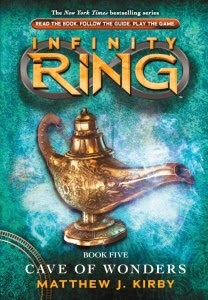 You released
a second book on the same day – the fifth book in the INFINITY RING series,
CAVE OF WONDERS, which is an awesome book (shameless plug here: once you’ve
read this and loved it, check out Book 6: BEHIND ENEMY LINES. The author tells
me it’s terrific! ;-) ) What can you tell us about this?
You released
a second book on the same day – the fifth book in the INFINITY RING series,
CAVE OF WONDERS, which is an awesome book (shameless plug here: once you’ve
read this and loved it, check out Book 6: BEHIND ENEMY LINES. The author tells
me it’s terrific! ;-) ) What can you tell us about this?
Working on the INFINITY RING series has been a ton
of fun, hasn’t it? I love history now, but that wasn’t always the case. When I
was younger, “history” meant names and dates, mere cold facts. As I grew older,
I realized that history is much more than that. It’s the story we tell about
ourselves. It’s how we make sense of who we are and how we got here. The premise
of the INFINITY RING series explores this in a way that brings key points in
history alive. Readers see how our world might be changed if events had
happened differently. Book five takes place at the end of Baghdad’s Golden Age,
on the eve of its destruction by Genghis Khan’s grandson.
 What’s
coming up next for you?
What’s
coming up next for you?
In a few months, on January 28th, I’ll
be kicking off a new series called THE QUANTUM LEAGUE. It’s a magical crime
saga, and the first book, SPELL ROBBERS, is a pretty classic heist novel. Think
Ocean’s Eleven with magic. Fast-paced, with lots of twists and turns and
double-crosses. Once again, it’s a real departure from my previous projects,
but I love taking on ideas that are new and different.
Quick
questions here:
Summer or
Winter?
Winter!
Must-see
place before you die?

Man, I love to travel. It would be impossible to
pick just one place, but I’ll say the Lascaux Caves. To stand there and connect
with history that deep? I can only imagine how profound that would be.
Irresistible
snack?
Grape Hi-Chews
The last
movie you saw and loved?
GRAVITY. Absolutely brilliant.
Monday, November 11, 2013
Fall YA Fantasy Covers: Gorgeous & Eerie

Fantasy covers for a young-adult audience tend to go with the flow—specifically, flowing dresses and hair. This year’s gorgeous fall covers have some of that—okay, a lot of it—but most of those we collected go off in various cool directions.
LOTS of cool directions. Early on, we despaired of finding any common
themes at all. But then we looked closer and noticed . . . The Bare Shoulder.
Yes! *fist pump*
These stunning covers are from books with pub dates between July and
December 2013. We defined “young adult” as written for teens 12 and older.
The covers start after the "read more" jump. As always, if we missed one you wish we’d caught, please
link to it in the comments. And—as always—we want to know your favorites!
Saturday, November 9, 2013
November Shamelessness
Greetings Inkies! We have some fantastic shamelessness to share with you today!
First of all, teen voters around the country awarded the #2 slot to Jennifer Nielsen's THE FALSE PRINCE for YALSA's Teen Top Ten list. (http://www.ala.org/yalsa/

And next on our shameless list, Vicky Smith, children’s and teen’s editor at Kirkus Reviews, wrote a blog
post about Ellen Booraem who she called “One of
the Best Kids’ Writers You’ve Never Heard Of.” She praised TEXTING THE
UNDERWORLD and Ellen’s two earlier books for “funny, heartfelt examinations of
life’s Big Questions.” All of Ellen’s
books have gotten starred reviews from Kirkus. And may we say that we at the Inkpot wholeheartedly agree with Ms. Smith!

Next Saturday, at the annual conference of the American
Association of School Librarians in Hartford, CT, Ellen will join other
middle-grade fantasy writers on a panel called “Head in the Clouds, Feet on the
Ground: The Role of Fantasy in the Real World.” If you are like me, you are probably wishing you could be there also!
So that's it for the shamelessness this time. Congratulations to Jennifer and Ellen B!!
Wednesday, November 6, 2013
Interview with Erin Bow, author of SORROW'S KNOT
 I am thrilled to be interviewing Erin Bow, whose second
book, SORROW'S KNOT (isn't that an awesome title?), was released last week!
I am thrilled to be interviewing Erin Bow, whose second
book, SORROW'S KNOT (isn't that an awesome title?), was released last week!
Your first book, Plain Kate, was Russian-based fantasy.
Your second, Sorrow's Knot, seems (correct me if I'm wrong!) inspired by at
least one Native American culture. How do you decide where to go for your
inspiration? What comes first, the research or the story?
There's a story behind the setting of Sorrow's Knot.
I met the heroine, Otter, long before I knew much about where she lived.
I knew she lived in a whispery, haunted forest, and that seemed good enough.
I put that forest in the middle of what Diana Wynn Jones called
"Fantasyland." (see: https://www.goodreads.com/work/quotes/1044747-the-tough-guide-to-fantasyland-the-essential-guide-to-fantasy-travel)
For a long while Otter and her friends wandered around Fantasyland Forest,
picking up horses and swords, but the story wouldn't quite come together.
Then I visited the Black Hills in South Dakota.
The Hills -- actually they are small mountains -- are very strange. The rise up out of the prairie, stoney and literally black, because of the black pine trees that cover them. Inside the forest there, the light is different, and the air is different. It's a strange, numinous place, and holy to nearly everyone who's lived in sight of it. Knowing it was holy it was with some trepidation that I set the story there. But it felt, that day, as if I'd walked into Otter's world.
So it was at that point that I stopped and did research.
A LOT of research. Architecture, gardening, ethnobotany,
storytelling, drumming, hunting, foraging, stone knapping, rope making -- there
was a lot. I wasn't trying to make Otter and her people an historically
accurate depiction of (say) the Hidatsa (from whom I borrowed the houses and
gardens) because when you start with a world where the dead prey on the living
and give women (and on


That DOES
sound like a lot of research - I'm slightly overwhelmed just reading your list!
Do you enjoy research, or do you see it as something you have to do to get into
the story (or -- like me – a little of both?)
I do like research -- part of what I really like about
writing books is that you get to dig deep into stuff. I'm the kind of
person who goes into a bookstore and sees a gorgeously illustrated 800 page
book on things to do with ropes on sailing ships and am just THRILLED that
someone knows that much about knots and lashings! And this, despite
getting seasick in bathtubs. So writing is, in one way, just a channel
for me being really geeky.
On the other hand, every time I write an historical, I swear
I will never write another historical. Ugh, it's ENDLESS.
Did you ever have to/get to go back to the Black Hills to fill in details/descriptions for your story? In that one paragraph, by the way, you managed to add them to my bucket list.)
I have been
back, once. My extended family farms in South Dakota,
so the Black Hills are not too far out of the
way. But most of what I've done has been from photos and books, plus some
locals and experts who answered questions and gave me assorted lessons.
The acknowledgements list in this book is long.
Also -- you
need to go to the hills! I didn't even tell you about the buffalo herds!
Or the caves!
You say
you "stopped" to get into the research. How do you know when you've
done enough research and you're ready to get back into the story?
It's a
paradox, isn't it -- it's hard to know what to research before you write, but
hard to know what to write until you do the research. It's tricky, too,
because you want to write too early (because writing is awesome and research is
hard) and also want to use research as means of procrastination (because
research is awesome and writing is hard). For me it's always a dynamic
balance, nothing quite as clean as stop and start. There are periods,
especially early on, where I do a lot of research and write while knowing that
most of the writing may need to go out the window. There are periods
later when I mostly write and leave the research questions on little notecards
so that I don't break my own flow. And at any point that balance may
shift, if only briefly.
The real trick for me is to
do enough research that the world becomes natural and real, and the story flows
from inside the world. For instance, in my current work-in-progress my
characters are on an epic cross-continent horseback journey. This is
a problem for me because when I started the story I'd never been on a horse.
(I have since taken a couple of lessons, and think I really nailed the
bit where my protagonist rides for the first time, is awkward and terrified,
and later very sore.) I knew I'd done enough horse-ish research when the
horses began to suggest stories. I stopped moving them around the board
and they started to move the novel on their own. Otter's world is more
complicated than that, because the research was so multifaceted, but at a
certain point there was the same kind of shift.
Perhaps not entirely relevant, but hey, it's my interview. So: since you
mentioned The Tough Guide to Fantasyland - what's your favorite Diana Wynne
Jones book?
They say
you never forget your first, and mine was Charmed Life. Still my
favourite, though I usually end up reading the entire Chrestomanci series every
time I pick it up. Also Fire and Hemlock. And Howl's
Moving Castle. Ummm. I could start to get carried away here
....
So could I, so I will resist the temptation to... oh, okay. The Chrestomanci series first, Howl's Moving Castle second, and then... right, RESISTING NOW.
To find out more about Erin and her fabulous book, you can check her out at http://www.erinbow.com/.
Subscribe to:
Posts (Atom)