
Of Aiken's books, China Miéville says, "If that kind of writing hits you at the right time when you're a child, the impact is like nothing else ever.”
 |
| The iconic Edward Gorey cover |
So what is it about Aiken’s Wolves that grabbed us as kids? And what can we learn from Aiken as writers?
(1) A
fast and furious plot pulls in readers.
Aiken’s
plot runs at a tremendous clip. If it
begins in the nursery-room, it soon becomes the stuff of high adventure. Young heiress Bonnie Green and her cousin
Sylvia are left to the tender care of governess Miss Slighcarp when Bonnie’s
parents travel overseas. Miss Slighcarp, however, is bent on seizing
Bonnie’s fortune and her home, the manor of Willoughby Chase. Despite the girls’ resourcefulness, Miss
Slighcarp eventually succeeds in exiling them to a vile orphanage. Outrageous adventures ensue before Bonnie and
Sylvia are restored to fortune.
 |
| Miss Slighcarp, Bonnie, and Sylvia, by Pat Marriott |
As a child, I read this book on the absolute edge of my seat, desperate to know what would happen next. And this, it seems, was what Aiken intended. She’s on record as saying, “The pace is faster when writing for children, who soon become bored by descriptions of thought-processes, flashbacks, overlong descriptions.”
If the pace is fast, however, there's still room for a great many twists and turns, as well as a general atmosphere of secrets and skulduggery. "Children do have a feeling for mystery," Aiken wrote. "This was certainly true of me, when I was very young."
(2) You
don’t have to do everything.
In
Aiken’s books, plot trumps character. It
seems this was deliberate.“Characters in children's books are simpler and more strongly defined, like those in Morality plays — personified abstractions,” Aiken once said.
This,
of course, is only one way to write a book, and plenty of readers prefer deeper
and more subtle characterization. But whether you’re a plot-driven writer or a
character-driven one, it’s helpful to remember that you don’t have to be all
things to all people. It’s okay to play
to your strengths.
 |
| Joan Aiken at her desk |
(3) Be
as quirky as you want, but get the details right.
Like
many readers, I first encountered the pleasures of alternate history in Aiken’s
books. Aiken's early nineteenth century
isn't ours. Instead it's a charmingly off-kilter world of scheming malcontents, eccentric aristocrats,
absentminded adults, and Dickensian dark doings. Voracious wolves terrorize all England. A Nantucket sea captain hunts for the great
pink whale. The jovial Stuart king James
III struggles against Hanoverian plotters.
No
matter how absurd the premise, the details are exquisitely executed. Take this moment, for instance, when Sylvia
is alone on a train with a stranger, and a wolf leaps through a broken window:
Sylvia screamed. Another instant, and a wolf precipitated itself through the aperture thus formed. It turned snarling on the sleeping stranger, who started awake with an oath, and very adroitly flung his cloak over the animal. He then seized one of the shattered pieces of glass lying on the floor and stabbed the imprisoned beast through the cloak. It fell dead.
"Tush" said Sylvia's companion, breathing heavily and passing his hand over his face, "Unexpected- most."
Is it any surprise that I believed in those wolves absolutely? Or that I was sure that there really had been a King Jamie III? I vividly remember consulting the encyclopedia at 11, and being bewildered as to why he wasn’t there in the list of British monarchs.
(4) Have
fun.
Aiken
clearly had a great time reinventing the nineteenth century, which gives the
story a lot of its brio. She also had almost as much fun with names as
Dickens did: In addition to Letitia
Slighcarp, we get Pattern the nurse, malevolent Gertrude Brisket, and Mr.
Friendshipp the Inspector. My favorite,
however, might just be Abednego Gripe the attorney. In later books, we meet Captain Jabez Casket
and his daughter Dutiful Penitence, as well as the immortal guttersnipe Dido
Twite.
(5) Be
open to suggestion.
Joan Aiken never intended The Wolves of Willoughby Chase to be the start of a series, but when it did well, she wrote another book set in the same world, Black Hearts in Battersea. She believed this would be the last book.
Soon, however, she received "a heartbreaking letter from an American child" about Dido Twite, one of the characters in Black Hearts. As Aiken later recalled, the letter asked, "‘Why did she have to die? She was such a good character’ (with no address on the letter so I was unable to reply). [That] obliged me to rescue her from the sea in Nightbirds on Nantucket. From then on I had become addicted to her” — after which the series continued on for many more books.
Joan Aiken never intended The Wolves of Willoughby Chase to be the start of a series, but when it did well, she wrote another book set in the same world, Black Hearts in Battersea. She believed this would be the last book.
Soon, however, she received "a heartbreaking letter from an American child" about Dido Twite, one of the characters in Black Hearts. As Aiken later recalled, the letter asked, "‘Why did she have to die? She was such a good character’ (with no address on the letter so I was unable to reply). [That] obliged me to rescue her from the sea in Nightbirds on Nantucket. From then on I had become addicted to her” — after which the series continued on for many more books.
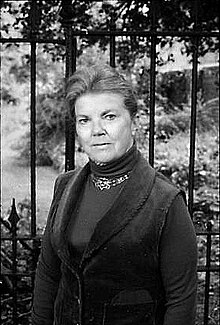 |
| Joan Aiken (1924-2004) |
(6) Be
persistent.
The Wolves of Willoughby Chase was a long time in the making. According to her official website, Aiken
started the story in 1952, but set it aside to nurse her
husband who had tuberculosis. He
died in 1955, after which Aiken needed to work as a copywriter to support her children. It was only in 1961 that she managed to finish the book. It then languished on her agent’s windowsill for a year.
When
the book was finally published in 1962, however, it was an immediate triumph. Fifty years later, The Wolves of Willoughby Chase remains in print and is considered a classic.
Long
may it flourish!
***
