
Today we welcome author Rachel Hartman to the Inkpot, to talk about her gorgeous debut YA fantasy SERAPHINA. It only took me a chapter to fall in love with this book, between the beautifully-realized and complex world and the determined, clever, wry protagonist struggling with her own identity, romance, philosophy, and Dragon-Human politics. I'm not the only one who loved this book: it's already received four starred reviews and is number two on the Summer Kid's Indie Next List!
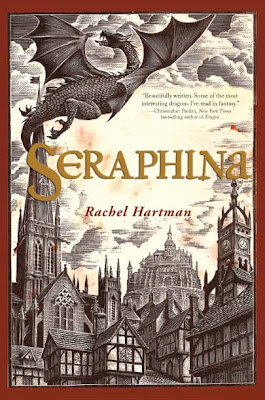
SERAPHINA is available now in stores! [SPOILER ALERT: the Indie Next blurb on that page gives away certain plot details you might not want to know. So do a number of other reviews, so be warned] You can also learn more about Rachel and her books at her website!
Thanks for joining us, Rachel! On your blog you say that it took you eight years to write SERAPHINA (or rather, to write four different novels that were steps along the way to the final version). You've also written (and illustrated!) a comic series AMY UNBOUNDED, which is set in the same world as SERAPHINA, and (if I understand correctly) even features a few of the same characters. Can you tell us what it was like write a book on top of such a foundation? Were there any particular challenges or advantages? How much did the book change over the course of those eight years?
There was one obvious advantage to setting the novel in the same world as the comic: I had less active world-building to do. There was this whole infrastructure already in place, a big stage where new characters could come out and have their own dramas. Any time I needed a reminder of the world’s aesthetic, I even had a handy visual reference! That part was wonderful.
I didn’t anticipate what the challenges would be at all. One challenge was that I had this whole other cast of characters from the comic series, and they all wanted to pop into the novel for cameo appearances. I remember my agent identifying these very characters and asking, “Why are they even in the story?” That forced me to look closely and see where I was being self-indulgent.
Another challenge was that with so much of the world already built in such detail, I initially felt little need to delve into it much. The book started as an intimate family tragedy, like Ibsen with dragons. This was a source of befuddlement for agent and editors both, the fact that I had set such a small, quiet story in an enormous, complicated world. It was as if I had been cultivating a single begonia in the middle of a great garden. Maybe it was the most beautiful begonia in the world, but here was all this garden going untended. This struck them as a terrible waste.
Each successive version of the novel has expanded the scope of the plot, the better to fit into the world I had already built. Only echoes of the original remain, mostly in scenes where Seraphina interacts with her father. So yes, the book has changed substantially, but I really believe it has changed for the better each time.

Four decades of peace have done little to ease the mistrust between
humans and dragons in the kingdom of Goredd. Folding themselves into
human shape, dragons attend court as ambassadors, and lend their
rational, mathematical minds to universities as scholars and teachers.
As the treaty’s anniversary draws near, however, tensions are high.
Seraphina Dombegh has reason to fear both sides. An unusually gifted
musician, she joins the court just as a member of the royal family is
murdered—in suspiciously draconian fashion. Seraphina is drawn into the
investigation, partnering with the captain of the Queen’s Guard, the
dangerously perceptive Prince Lucian Kiggs. While they begin to uncover
hints of a sinister plot to destroy the peace, Seraphina struggles to
protect her own secret, the secret behind her musical gift, one so
terrible that its discovery could mean her very life.
SERAPHINA is available now in stores! [SPOILER ALERT: the Indie Next blurb on that page gives away certain plot details you might not want to know. So do a number of other reviews, so be warned] You can also learn more about Rachel and her books at her website!
Thanks for joining us, Rachel! On your blog you say that it took you eight years to write SERAPHINA (or rather, to write four different novels that were steps along the way to the final version). You've also written (and illustrated!) a comic series AMY UNBOUNDED, which is set in the same world as SERAPHINA, and (if I understand correctly) even features a few of the same characters. Can you tell us what it was like write a book on top of such a foundation? Were there any particular challenges or advantages? How much did the book change over the course of those eight years?
There was one obvious advantage to setting the novel in the same world as the comic: I had less active world-building to do. There was this whole infrastructure already in place, a big stage where new characters could come out and have their own dramas. Any time I needed a reminder of the world’s aesthetic, I even had a handy visual reference! That part was wonderful.
I didn’t anticipate what the challenges would be at all. One challenge was that I had this whole other cast of characters from the comic series, and they all wanted to pop into the novel for cameo appearances. I remember my agent identifying these very characters and asking, “Why are they even in the story?” That forced me to look closely and see where I was being self-indulgent.
Another challenge was that with so much of the world already built in such detail, I initially felt little need to delve into it much. The book started as an intimate family tragedy, like Ibsen with dragons. This was a source of befuddlement for agent and editors both, the fact that I had set such a small, quiet story in an enormous, complicated world. It was as if I had been cultivating a single begonia in the middle of a great garden. Maybe it was the most beautiful begonia in the world, but here was all this garden going untended. This struck them as a terrible waste.
Each successive version of the novel has expanded the scope of the plot, the better to fit into the world I had already built. Only echoes of the original remain, mostly in scenes where Seraphina interacts with her father. So yes, the book has changed substantially, but I really believe it has changed for the better each time.
